
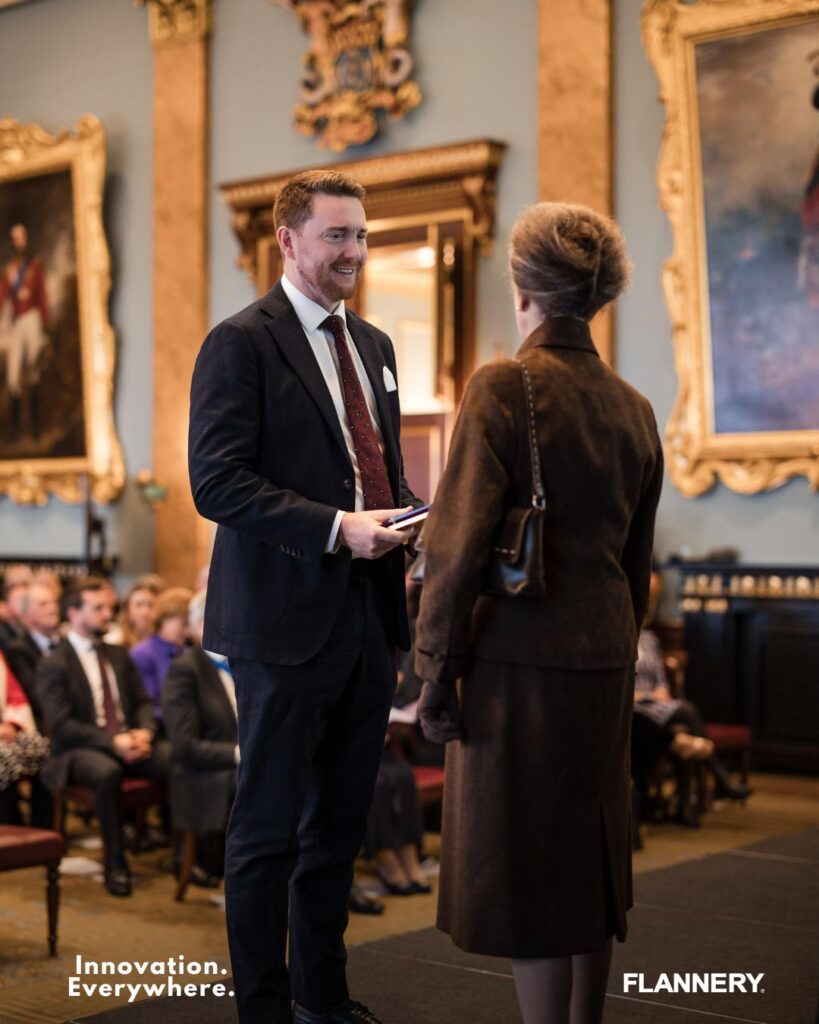
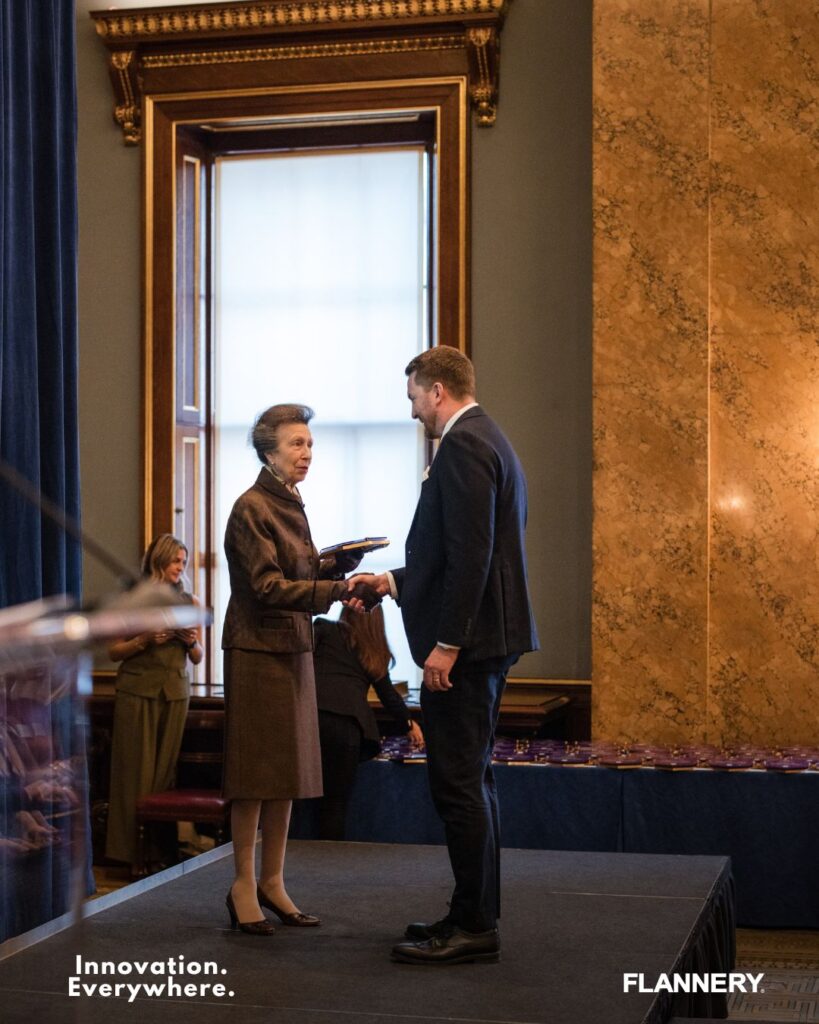
When P Flannery Plant Hire received a Princess Royal Training Award in 2025, it recognised a bold, employer-led approach to tackling one of the construction industry’s most persistent challenges: a critical shortage of skilled plant operators. Through the development of its Skills Bootcamps, the business has created a reliable pipeline of talent for its own workforce and has also opened up employment opportunities for individuals facing significant barriers to work.
Addressing a critical skills gap
P Flannery is a leading UK provider of operated plant hire, working across major infrastructure and construction projects nationwide. As demand for skilled labour across the built environment has intensified, the business identified a growing gap between industry needs and available talent. Traditional training routes, such as apprenticeships, often require long-term commitment and financial stability; factors that can be prohibitive for many individuals.
In response, P Flannery launched its Skills Bootcamps in October 2022. Designed as a short, intensive alternative to longer training pathways, the programme offers a two-week intervention that takes individuals from little or no experience to being site-ready. This model enables learners to quickly gain the skills and certifications needed to begin work as plant operators, providing an immediate route into employment.
Opening doors to those facing barriers
A defining feature of the bootcamps is their focus on inclusivity. P Flannery has proactively targeted individuals who face barriers to accessing training or employment, including those who are not in education, employment or training (NEET), ex-offenders, care leavers, veterans and the long-term unemployed.
The programme’s diversity statistics significantly exceed industry norms. While women account for just 1% of the wider trades workforce, 10% of learners on the bootcamps are female. In addition, 14% of participants report having a learning disability, difficulty or health condition, and 45% come from ethnic minority backgrounds. In addition 27% of learners are NEET, demonstrating the programme’s success in engaging individuals who are often furthest from the labour market.
This targeted outreach is supported by strong community engagement and social value activity, particularly in areas where P Flannery is delivering major projects. By aligning its recruitment with local need, the business is able to create employment opportunities within the communities it serves.
An inclusive approach
Central to the success of the bootcamps is a tailored and supportive learning model. Every participant begins with an individual learning plan, developed at enrolment and reviewed throughout the programme. This ensures that training is adapted to each learner’s starting point, whether they face language barriers, learning difficulties or limited formal education.
The programme incorporates a range of inclusive learning techniques. Interpreters are used to support learners with English as a second language, while alternative formats such as coloured overlays and audio-supported e-learning help those with dyslexia or low literacy levels. Practical, hands-on teaching methods reduce reliance on traditional classroom-based learning, making the programme accessible to a broader range of participants.
As Aaron Davis, Safety and Skills Director at P Flannery explains:
“Construction isn’t a sector where a lack of GCSEs, A-Levels or a lack of ability for literacy or numeracy means you’re prevented from an employment opportunity. If someone can get out of bed in the morning and be where they need to be on time, we can support and train them to have a fulfilling career.”
P Flannery also operates as an “employer provider,” meaning training is directly aligned with real job requirements. This creates a seamless transition from learning to employment and ensures that all participants are trained to industry-ready standards.
Driving employment outcomes and progression
Since launch, the Skills Bootcamps have trained over 2,500 individuals, with around 700 learners now participating each year. Graduates follow one of two pathways: many move directly into roles within P Flannery, while others are supported into employment across the wider construction sector through the company’s client and supply chain networks.
To maximise outcomes, a dedicated resourcing team tracks participants for six months after completion, providing ongoing support and connecting them with job opportunities. This engagement helps ensure that learners not only secure employment but are able to sustain it.
P Flannery’s data shows that learners from disadvantaged or “hard to reach” groups achieve the same outcomes as their peers. Aaron explains why this is the case:
“We’ve found that learners from hard-to-reach groups have exactly the same achievement and outcomes rates as those not from disadvantaged backgrounds. We’ve realised that this is due to the flexibility of our training approach and the support mechanisms that we put in place, from enrolment through to completion. It doesn’t matter where your starting point is, we can support you to achieve the end goal.”
This parity of achievement highlights the effectiveness of the programme’s inclusive design and reinforces the principle that, with the right support, background isn’t a barrier to success.
Investing in skills to drive business performance
The impact of the bootcamps extends beyond social value. For P Flannery, the programme has become a core part of its workforce strategy, providing a steady pipeline of skilled, job-ready employees trained to the company’s high standards. This reduces reliance on external recruitment and ensures greater consistency in capability across the workforce.
The business has also invested significantly in its training capacity, retraining experienced plant operators as qualified instructors. By maintaining their salaries and supporting their transition into training roles, P Flannery has addressed a wider industry challenge around the shortage of trainers, further strengthening the long-term sustainability of the model.
A sustainable model for sector growth
The Princess Royal Training Award recognises not only the quality of P Flannery’s training programme but also its wider impact. By removing barriers to skills, the bootcamps are enabling individuals to access stable, well-paid employment, while helping to address critical workforce shortages in the construction sector.
To find out more about the Awards click here.
To find out more about P Flannery click here.
0 Comments